The hidden cost of fractions of a percent
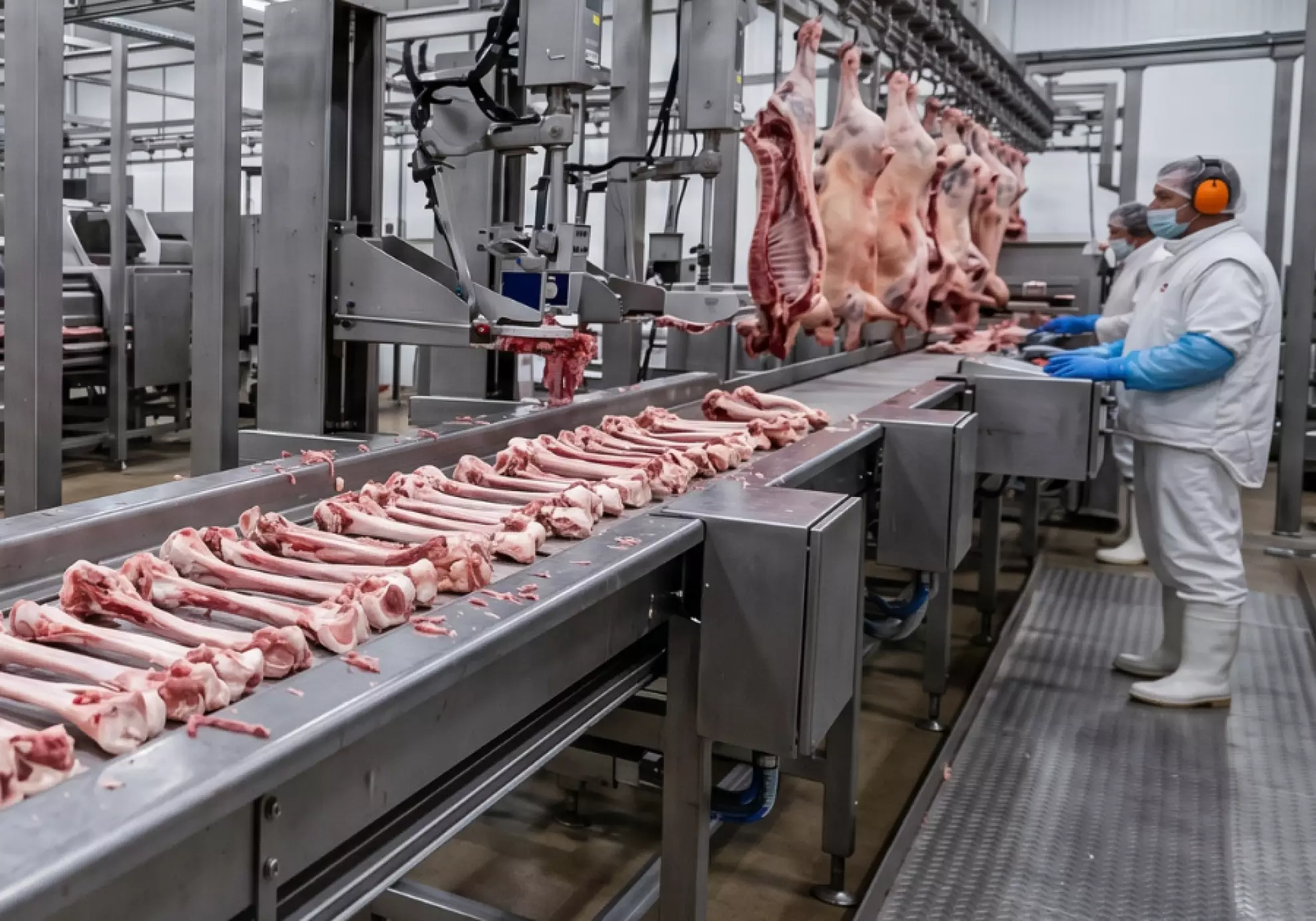
A meaningful share of that loss is residual meat left on bone, material that is biologically recoverable but operationally invisible. At line speeds typical of modern facilities, the human eye cannot consistently catch every fragment, and traditional automation cannot adapt to the natural variability of each carcass. The result: yield gaps that compound shift after shift into seven-figure annual losses.
Computer vision is changing that equation.
Why traditional quality control falls short
Three structural problems make manual quality control unreliable on a modern processing line:
Biological variability. Unlike automotive assembly, where every part is identical, every carcass is unique. Rigid mechanical systems calibrated to average dimensions consistently miss the edge cases and edge cases are the rule, not the exception, in animal protein.
Line speed versus human attention. When a station processes thousands of units per shift, operators face a tradeoff between speed and thoroughness. Most lines optimize for throughput, which means small amounts of recoverable material are routinely left behind to keep pace.
Lack of objective feedback. Without measurement, there is no improvement. Supervisors cannot watch every station simultaneously, and post-shift audits arrive too late to correct the behavior that produced the loss. Coaching becomes subjective, and yield variability between operators persists.
The cumulative effect is what industry analysts sometimes call “invisible loss” material that never appears in a defect report because no one was looking at the right moment.
How computer vision systems detect residual meat
A modern computer vision system for yield recovery combines three layers: high-resolution industrial cameras at each workstation, deep learning models trained on annotated processing footage, and a real-time feedback interface for operators.
The model is typically trained to perform pixel-level segmentation of the cut surface, distinguishing bone, fat, connective tissue, and residual muscle. When the model identifies meat that should have been recovered, it flags the unit before it leaves the workstation. Detection latency on modern industrial GPUs is well under a second, which is critical: feedback that arrives after the unit has moved down the line cannot drive correction.
This is not theoretical. Real-time yield reporting and plant-floor performance feedback are already established categories in meat processing software (see, for example, vendor documentation from CAT Squared and other industry suppliers). The novelty of computer vision is not the feedback loop itself it is the ability to inspect every unit rather than spot-check, and to do so without slowing the line.
What makes a good detection model
Three characteristics separate production-grade systems from research prototypes:
- Robustness to lighting and occlusion. Processing environments are wet, reflective, and visually noisy. Models must perform consistently across shifts, equipment angles, and product variability.
- Low false-positive rates. Operators quickly learn to ignore systems that cry wolf. Production deployments target low single-digit false-positive rates, with the right threshold depending on line economics.
- Continuous learning. Carcass characteristics shift seasonally, by supplier, and by genetic line. Models that retrain on recent footage outperform static models within months.
Operational impact beyond yield
Yield recovery is the headline metric, but processors who deploy computer vision typically report secondary benefits that compound the ROI:
Objective operator coaching. Recorded clips of flagged units replace subjective performance reviews. Training conversations become evidence-based, and skill gaps close faster.
Continuous audit trail. Every unit processed has an associated quality record. This is valuable for compliance, customer audits, and root-cause analysis when downstream issues arise.
Throughput stability across shifts. Because the system applies the same standard regardless of operator fatigue or experience, output quality stops varying with the time of day or the composition of the crew.
Data for upstream decisions. Aggregated detection data reveals patterns which suppliers produce harder-to-process carcasses, which equipment configurations correlate with higher loss, which training interventions actually moved the metric. Plants gain a feedback loop that previously did not exist.
Build versus buy: what processors should evaluate
For plant managers and operations leaders considering a computer vision deployment, a few practical questions are worth answering before any vendor conversation:
- Where exactly is the loss? A short audit, even a manual one over a few shifts, usually identifies one or two stations where the recovery gap is concentrated. Solving the 80/20 first reduces project scope and accelerates payback.
- What is one percentage point of yield worth annually? This number, multiplied by the realistic recovery a system can deliver, sets the upper bound of what the investment can justify.
- Is the IT environment ready? Edge inference requires reliable power, networking, and a place to store training data. Most plants need a small infrastructure assessment before deployment, not a major overhaul.
- What does the integration look like? A good system observes without disrupting. Lines that have to slow down or be re-engineered around the cameras lose much of the ROI before the model ever runs.
What this looks like in practice at Zega
At Zega, we build computer vision systems for industrial environments where small visual signals carry real economic weight. Our work in AI-powered waste collection oversight addresses a structurally similar problem: high-volume operations where human monitoring cannot scale, where each missed detection has measurable cost, and where real-time feedback changes operator behavior.
The same engineering principles robust detection under difficult visual conditions, low-latency inference, integration that respects existing workflows translate directly to meat processing. The domain expertise differs, the technical foundation does not.
The bottom line
Margins in meat processing are tightening. Cattle and feed input costs have run at multi-year highs, labor is harder to retain, and customer expectations on consistency continue to rise. In that environment, the half-percent of yield that no one was looking at becomes the difference between a profitable plant and a struggling one.
Computer vision does not replace operators. It gives them, and the supervisors above them, the visibility that high-speed processing has historically denied. For processors willing to invest in the right system and the operational discipline around it, the return is measurable, durable, and compounding.
Ready to explore what this could look like in your facility?
Talk to our team about a computer vision feasibility assessment for your production line.